trigonal Synthetic synthetic corundum
Czochralski Sapphire (Crystal)
Formula Al2O3
Crystal Structure
 #! Species: Czochralski Sapphire
#! System: Trigonal (-3m)
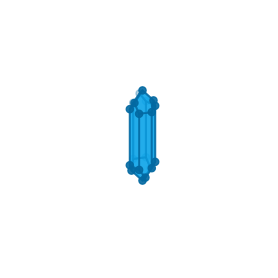
#! Habit: Cylindrical boule with prismatic habit
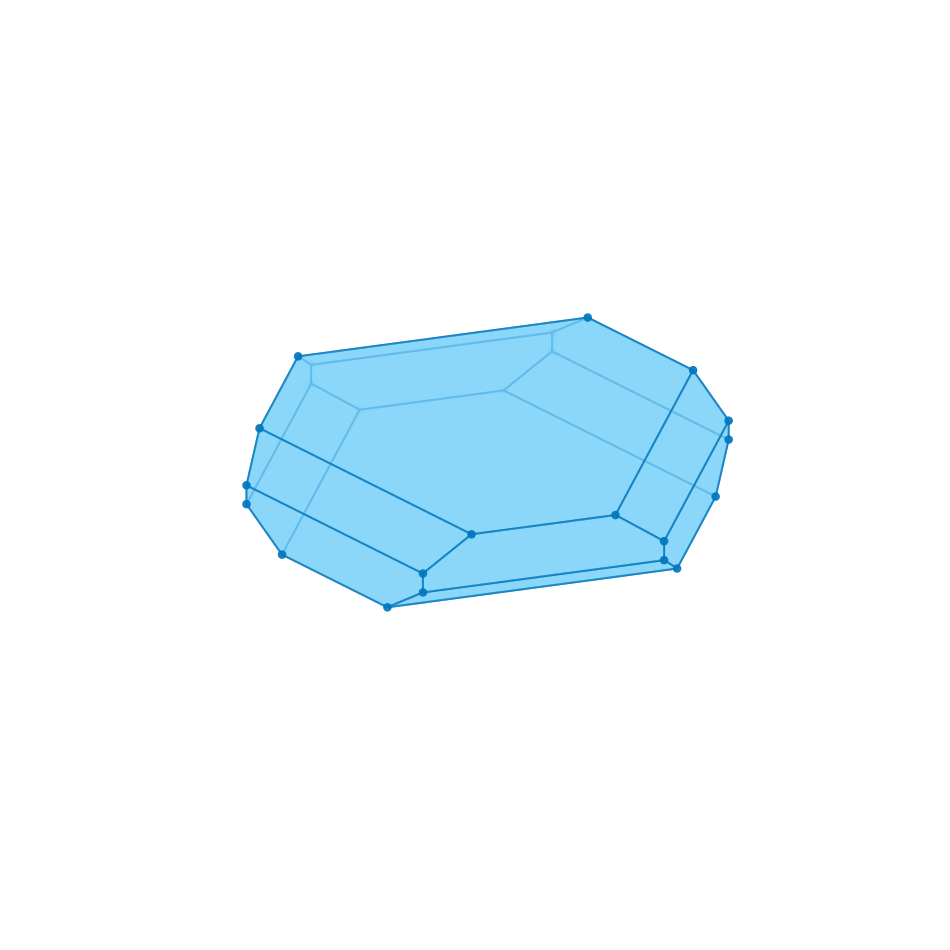
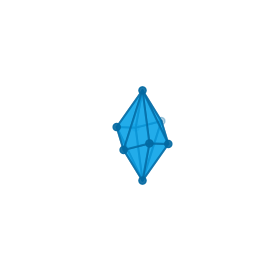
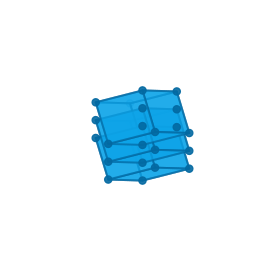
trigonal[-3m]:{10-10}@1.0 + {10-11}@0.8 + {0001}@0.5
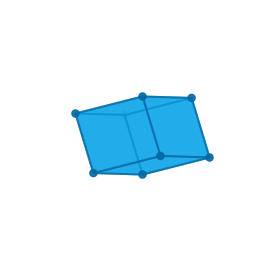
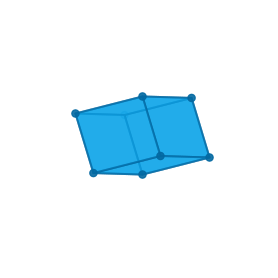
trigonal
-3m
{10-10} {10-11} {0001}
Quick Facts
Hardness
None
Specific Gravity
3.99
Refractive Index
1.762
Optical Character
Uniaxial -
Physical Properties
- Crystal System
- trigonal
- Hardness (Mohs)
- None
- Specific Gravity
- 3.99
- Cleavage
- None (parting on {0001} and {10-11})
- Fracture
- Conchoidal
- Lustre
- Vitreous to adamantine
Optical Properties
- Refractive Index
- 1.762
- Birefringence
- 0.008
- Optical Character
- Uniaxial -
- Dispersion
- 0.018
- Pleochroism
- weak: Blue / Pale blue to colourless
- Fluorescence
- Weak to inert (Linde blue may show weak orange-red under SWUV)
Origin & Identification
- Origin
- Synthetic
- Growth Method
- Czochralski (melt Pulling; Seed Rod Pulled Upward From Melt Surface Under Rotation)
- Manufacturer
- Linde Division (Union Carbide, USA); Kyocera Corp. (Japan); Crystal Systems Inc.; Rubicon Technology; Saint-Gobain
- First Produced
- 1958
- Diagnostic Features
- Tight curved growth striae (finer and more closely spaced than Verneuil; concentric arcs around growth axis under immersion); absence of gas-bubble trains (characteristic of Verneuil but absent in Czochralski); absence of curved colour banding; platinum-group metal (PGM) rod-like inclusions from seed holder (highly diagnostic of Linde boules); no natural inclusion suite (no rutile silk, no zircon, no negative crystals); Linde star sapphire: artificially precipitated rutile needles (too perfect and uniformly spaced under magnification; typically on flat-back synthetic dome)
Characteristics
Colours
BlueColourlessVarious (by doping)
Common Inclusions
Tight curved growth striaePlatinum-group metal rod inclusions (PGM from seed holder)Absence of natural inclusions (no rutile silk)
Notes
Czochralski sapphire grown from melt pulled upward on rotating seed rod; produces a boule rather than Verneuil pear-shaped boule. Key distinction from Verneuil: tighter curved striae (vs broader curves in Verneuil); no gas-bubble trains; PGM inclusions from seed holder. EDXRF/LA-ICP-MS: extremely low trace elements (Ga typically below detection in natural sapphire >1 ppm). Linde star ruby/sapphire: Ti-doped then annealed to precipitate rutile. Gemmological properties and growth method from Read 7th ed. pp.193-195 (DOI 10.4324/9780080507224) [PARTIALLY_SUPPORTED]. No dedicated peer-reviewed gemmological paper for Czochralski sapphire identification retrieved via API.
Natural Counterpart
The natural gem this synthetic imitates

Related Minerals
Other minerals in the trigonal system