trigonal Synthetic synthetic corundum
Kashan Flux Ruby (Crystal)
Formula Al2O3:Cr
Crystal Structure
 #! Species: Kashan Flux Ruby
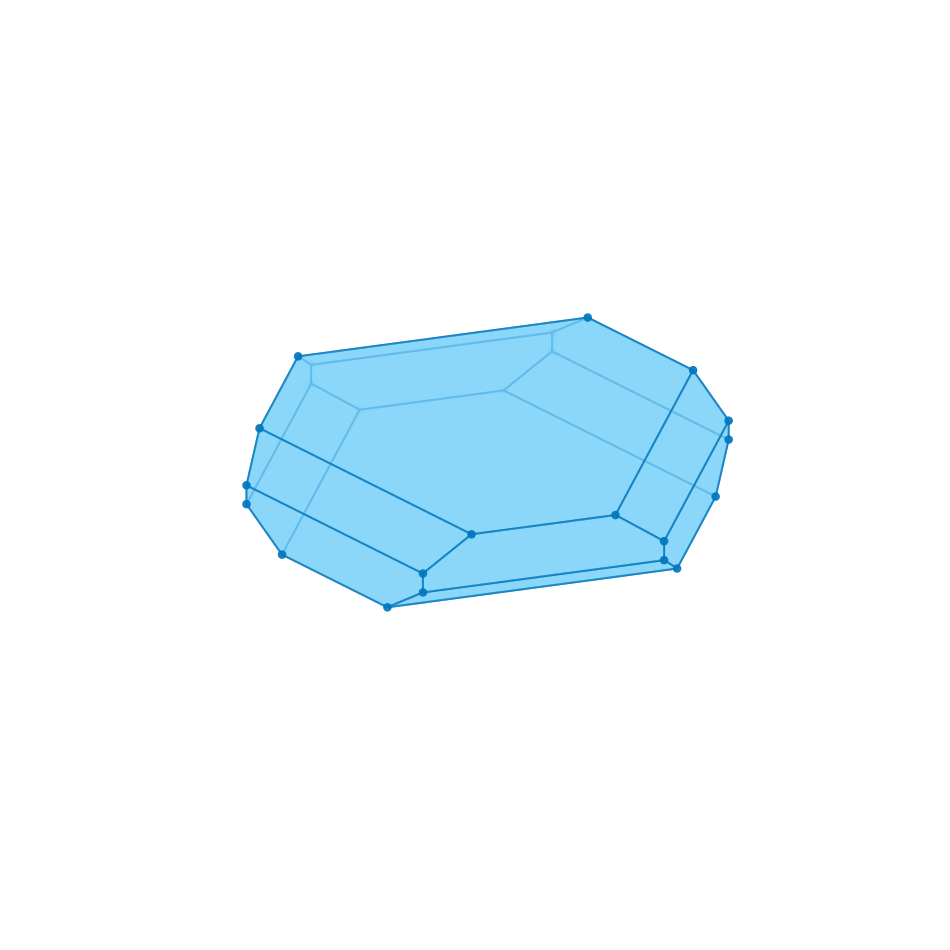
#! System: Trigonal (-3m)
#! Habit: Tabular to prismatic from Pt-crucible flux growth
trigonal[-3m]:{10-10}@1.0 + {10-11}@0.8 + {0001}@0.5
trigonal
-3m
{10-10} {10-11} {0001}
Quick Facts
Hardness
None
Specific Gravity
3.99
Refractive Index
1.762
Optical Character
Uniaxial -
Physical Properties
- Crystal System
- trigonal
- Hardness (Mohs)
- None
- Specific Gravity
- 3.99
- Cleavage
- None (parting on {0001} and {10-11})
- Fracture
- Conchoidal
- Lustre
- Vitreous to adamantine
Optical Properties
- Refractive Index
- 1.762
- Birefringence
- 0.008
- Optical Character
- Uniaxial -
- Dispersion
- 0.018
- Pleochroism
- strong: purplish-red / orangey-red
- Fluorescence
- Very strong red (LW and SW UV; characteristic of pure Cr3+ environment)
Origin & Identification
- Origin
- Synthetic
- Growth Method
- Flux (molybdate-based Flux In Platinum Crucible; Slow-cooling Crystallisation; Independently Developed From Chatham Process)
- Manufacturer
- Kashan Inc. (produced 1968-1996; associated with Inamori/Kyocera technology)
- First Produced
- 1968
- Diagnostic Features
- Angular flux fingerprints (Kashan flux residue forms angular, more geometric fingerprint textures rather than the wispy cloud-like veils of Chatham/Knischka — angular, partially solidified flux inclusions visible under dark-field illumination); platinum platelets (flat hexagonal to irregular Pt metal from Pt crucible; same as other Pt-crucible flux products; diagnostic for all flux-grown corundum); absence of twinning (Kashan rubies rarely show polysynthetic twinning lamellae typical of natural Burmese ruby); absence of rutile silk (no fine straight rutile needles as in natural Mogok ruby); molybdenum trace (Mo from flux detectable by EDXRF; natural ruby has no Mo; highly diagnostic chemical signature); strong Cr fluorescence (both LWUV and SWUV; intense red from pure Cr3+ environment; natural Burma ruby also strong, but combination with Mo trace and Pt platelets is conclusive); absorption spectrum shows strong doublet at 692/694 nm (Cr3+ R-lines); no 450 nm Fe band (natural ruby often has Fe-related absorption at 450 nm from Thai/Cambodian origin)
Characteristics
Colours
RedPinkish-red
Common Inclusions
Angular flux fingerprints (geometric; Kashan-specific)Platinum plateletsAbsence of rutile silk
Notes
Kashan flux ruby distinguishes from generic flux ruby (Chatham/Knischka/Ramaura) by angular flux fingerprint geometry (Chatham = wispy veils); from generic flux ruby.yaml in DB. Two API-verified papers: Burch 1984, Journal of Gemmology 19(1):54 (DOI 10.15506/jog.1984.19.1.54) [VERIFIED]: "Some Observations on a Kashan Synthetic Ruby" — Pt platelets and angular flux fingerprints documented. Muhlmeister et al. 1998, Gems & Gemology 34(2):80 (DOI 10.5741/gems.34.2.80) [VERIFIED]: "flux-grown rubies in general show extremely strong red fluorescence under both longwave and shortwave UV." Mo trace by EDXRF: absent in natural ruby — chemical confirmation. Production 1968-1996; Inamori (Kyocera) technology. Distinguishes from hydrothermal (no Pt, chevron zoning) and from Verneuil (curved striae, gas bubbles, no Pt).
Natural Counterpart
The natural gem this synthetic imitates
Related Minerals
Other minerals in the trigonal system